Skip to Content

Arrow EZCut 350R

Multiple-Blade Digital Label Cutter & Finishing System

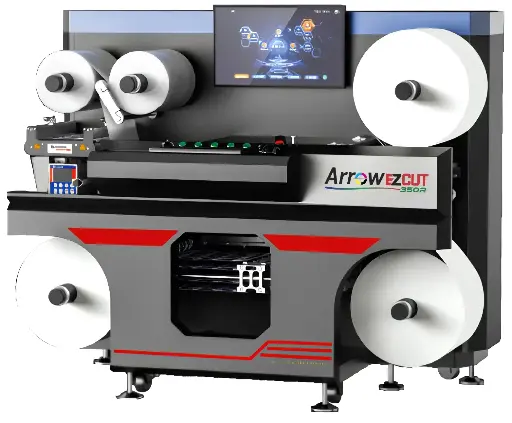
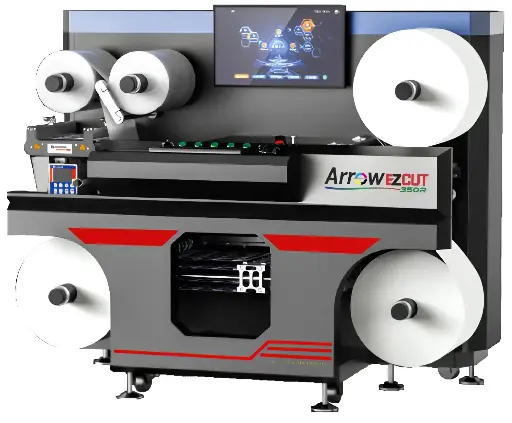
The Arrow EZCut 350R is an advanced multiple-blade digital label cutter designed for short to medium-run label production.

Equipped with up to six individually controlled cutting heads, automatic distance adjustment via AI software, and an integrated sheeting system, the EZCut 350R offers exceptional flexibility for on-demand label finishing.

This intelligent roll-to-roll solution performs cutting, slitting, laminating, and waste removal in a single workflow — all with high precision and minimal operator input. Compact, efficient, and easy to use, the EZCut 350R bridges the gap between affordability and professional-grade finishing.

0.00 Ft 0.00 Ft Tax Excluded


This combination does not exist.

Core Features


  • Multiple Cutting Heads: Up to six independently controlled heads for high-speed digital die-cutting.
  • Automatic Head Adjustment: The AI software automatically adjusts the spacing between cutting heads based on the label layout.
  • Digital Screw Transmission System: Ensures precise, repeatable cutting at speeds up to 9 m/min.
  • Integrated Sheeting System: Cuts roll material to sheet size, either inline or offline, without requiring additional hardware.
  • CCD Vision Registration: A high-precision camera and mark detection system for accurate alignment and auto job exchange.
  • Ultrasonic Web-Guiding: Maintains perfect material tracking during feeding and cutting.
  • Cold Laminating Module: Optional inline lamination enhances gloss and protection.
  • Advanced Waste Removal: Consistent waste matrix removal prevents tearing and keeps labels clean and clear.
  • Rotary Slitting System: High-speed rotary slitting (up to 100 m/min) with up to 15 slitters for flexible finishing.
  • Embedded AI Operating System: Integrated computer with LCD interface for intuitive job control.


Benefits


  • Flexible Workflow: Combines cutting, slitting, laminating, and sheeting in one machine.
  • Precise & Consistent: Maintains ±0.1 mm cutting accuracy for professional-grade results.
  • Cost-Efficient Operation: Digital die-cutting eliminates the need for mechanical dies, reducing waste.
  • Fast Job Changeover: Automatic mark detection and job recognition minimize downtime.
  • Compact Design: Easily fits into existing label production environments.
  • Scalable Productivity: Ideal for both small batch and medium-volume production.
  • Compatible Integration: Works seamlessly with digital label printers for inline finishing.


Ideal Applications


  • Blank and printed label finishing
  • Food, beverage, and cosmetic labels
  • Chemical and industrial labels
  • Pharmaceutical and healthcare labeling
  • Short-run roll-to-roll or sheeted label jobs
  • Stickers, tags, and promotional label production


Operational Advantages


  • Smart Automation: AI-controlled head movement and auto mark recognition streamline production.
  • Multi-Process Workflow: Simultaneously laminate, cut, slit, and rewind.
  • User-Friendly Control: The built-in computer features a large LCD, simplifying setup and monitoring.
  • High-Speed Slitting: Up to 100 m/min with adjustable rotary knives.
  • Precision Vision System: CCD camera ensures perfect registration across every run.
  • Flexible File Support: Accepts PLT and DXF files for seamless integration with standard design software.


Technical Specifications


Manufacturer

Arrow Systems, Inc.

Number of Cutting Heads

Standard 4, up to 6 heads

Working Speed

9 m/min (7 × 15 cm labels)

Max Label Length

800 mm

Max Label Width

330 mm

Cutting Media Width

100–350 mm

Max Roll Diameter

450 mm

Cutting Precision

±0.1 mm (repeat)

Slitting Speed

Up to 100 m/min

Slitting Precision

±0.1 mm

Slitting Width

10–330 mm

Slitting System

Rotary round-knife with position adjustment (max 15 slitters)

Laminating

Cold Lamination (optional backliner removal)

Feeding System

Ultrasonic Web-Guide System

Positioning Device

Electric Eye + CCD Camera

Job Exchange

Automatic via Mark & Code Detection

Operating System

Embedded Computer with AI Software & LCD Interface

Head Distance Adjustment

Automatic electronic control

Unwinder & Rewinder

1 each, mechanical expansion

Data Input

USB or Network Cable

Supported File Formats

PLT, DXF

Supported Materials

Stickers, Paper, BOPP, PET, PVC, etc.

Power Supply

AC 100–240 V, 50–60 Hz, 1000 W

Dimensions (L × W × H)

2080 × 1200 × 1640 mm

Packing Size

2213 × 2203 × 300 mm

Gross / Net Weight

1450 kg / 1400 kg

Optional Modules

Additional Rewinder, Multiple Slitting Units, Inline Sheet Cutter

Key Features of Chirip RIP Software


High-Speed Rasterisation Engine

As of now, Chirip processes PDFs into high-quality raster output with optimised multi-core performance, reducing processing time in production environments.

Advanced Colour Management (ICC-Based)

Supports full ICC workflows, including:


  • Device-link profiles
  • Grayscale and black preservation
  • Spot colour and named colour (like Pantone and RAL) replacement


Ensures consistent and predictable colour output across different print jobs and devices.

RIP Software for Multiple Printing Technologies

Chirip is designed to work across:


  • Industrial inkjet printing systems
  • Digital printing environments
  • Professional printing solutions

This flexibility allows long-term scalability and compatibility with evolving printing technologies.

Headless RIP Engine for Automation

The core RIP engine operates via command-line interface (CLI), enabling:


  • Full automation
  • Server-side processing
  • Integration into production pipelines


Ideal for OEMs and automated print systems.

Modular and Scalable Architecture

Chirip can be deployed as:


  • A standalone RIP system
  • A fully integrated OEM component
  • A scalable multi-system solution

Is It for You?

Chirip is designed to meet the industry’s current and future requirements while maximizing quality and productivity.

Discover more Contact us

Use Cases for RasterMaster

OEM & Integration Use Cases

(Primary)

Embedding a RIP engine into new printer systems

Replacing or upgrading legacy RIP components

Building automated print workflows

Developing custom printing solutions

Production Use Cases

(Secondary)

Increasing print throughput

Improving color consistency

Reducing manual workflow steps

Supporting complex print jobs

Who Should Use Chirip?

Printer manufacturers (OEMs)


Industrial print service providers


Engineering and R&D teams


System integrators


Software developers working with printing technologies


Product Packages

Chirip packages are designed to scale across different printing technologies and operational needs, from integration-focused OEM environments to fully managed production workflows.

Discover more Contact us

Chirip Core

The foundation for high-performance rasterization and automated workflows. Best suited for OEMs, developers, and system integrators who require a headless, integration-ready RIP engine.

Chirip Pro

Extended functionality with user interfaces and workflow control. Best suited for print environments that require both performance and operational control through a user interface.

Chirip Fusion

Customized solution designed to meet specific integration requirements. Best suited for OEMs and partners with specific technical or architectural needs.


Features of the Product Packages​

Output & Verification
  • Flexible composing and sending printer-compatible data streams
  • Bilevel data preview and verification
Platform support
  • Linux (Debian-based distributions)
  • Windows (10 and above)
Color Management
  • Advanced color profile management and assignment (ICC)
  • DeviceLink profile support and generation (ink limiting, color mapping)
  • Open spot color system with custom color libraries and flexible mapping workflows
  • Color profiling workflow support (measurement-based)
  • Grayscale and black channel preservation

Chirip Core

High-performance rasterization and automation for OEMs, developers, and integrators needing a headless, integration-ready RIP engine.

Integration
  • Command-line interface for easy automation and integration across standalone devices and server environments
  • Full offline operation
Processing & Performance
  • High-performance processing (multi-threaded, hardware-accelerated)
  • Advanced variable data printing (VDP) engine with layered composition and blending support
  • Deterministic rendering and full reproducibility
Adaptive media size handling for cut-sheet and continuous printing
Color matching and color replacement
Cost estimation (ink, printhead usage, media)
Printer presets (device configuration)
Flexible copy and collation handling
Advanced print layout and imposition tools (positioning, scaling, rotation, bleed)
Desktop application for print project preparation
Full-featured REST API for workflow automation and integration

Chirip Pro

Enhanced functionality with UI and workflow control for high-performance print environments.

Advanced support agreement (dedicated support, SLA, maintenance)
Advanced job management, storage, and queueing
Print engine supervisor for integrated hardware control
Production analytics and reporting
Vision system integration
Custom OEM and system-level integration

Chirip Fusion

Customized solution for OEMs and partners with specific integration and technical requirements.

Service and Customer Experience

Besides delivering the software, we provide a structured and transparent collaboration model.


Technology

Direct technical support


Accessability

Transparent issue tracking


Availability

Continuous communication throughout integration and operation


Directives

Guidance during implementation.


Conversations

Technical consultation.


Personalization

Custom development when required

Next Steps

Ready to integrate Chirip into your workflow?


Contact with our team

Technical Specifications

For those interested in more detail, the full technical specifications are available below.


Discover more Contact us

Core Capabilities


  • High-quality rasterization in RGB and CMYK
  • ICC-based color management with device-link support
  • Custom dithering and screening engine
  • PDF-optimized processing
  • Multi-layer composition with blend modes

System Architecture


  • Modular and scalable design
  • Multi-threaded processing
  • CLI-based headless operation
  • REST API and service-based orchestration
  • Full offline operation

Supported Formats


  • Input:
    • PDF (Grayscale, RGB, CMYK, mixed)
  • Output:
  • Bi-level data
    • ORF (Ophrys Raster Format)
    • BMP (visualization)
  • Continuous tone
    • TIFF
  • PNG

System Capabilities


  • Operating Systems:
    • Windows 10+
    • Linux (kernel 6.0+)
    • macOS (planned)
  • Minimum hardware:
    • x64-based system
    • Dual-core CPU @ 2.0 GHz (AVX2)
    • 32GB RAM
    • 512 GB SSD
  • Recommended hardware:
    • x64-based system
    • Octa-core CPU @ 4.5 GHz (AVX-512)
    • 64 GB+ RAM
    • 1 TB NVMe SSD
  • Performance optimization tips:
  • RamDisk usage

Performance Security


  • Optimized for SIMD instructions
  • Multi-core scaling for high-speed processing
  • Hardware-bound licensing for secure and stable deployment