
From Challenge to Success
Hafner Webshop Finally Found Its Voice
When Hafner first approached us, they were in a situation many companies quietly find themselves in: they had a webshop that looked almost finished from the outside, yet behind the polished screens nothing connected to the systems that actually powered their daily work. The design was clean, the structure seemed logical, the pages gave the impression of readiness, but the moment you looked for real functionality, prices, customer data, orders - the whole thing fell apart. The webshop simply had no link to JDE, their ERP system, which meant it couldn’t serve the business in any meaningful way.
It felt a little like stepping into a showroom full of beautiful furniture where none of the doors opened and none of the drawers contained anything.
Everything looked promising, but without the connection to JDE, the webshop couldn’t breathe.
This situation wasn’t entirely new to Hafner. Their previous webshop had been running in sync with an earlier ERP system for years, but as their operations grew more complex, it became clear that they had outgrown that setup. Moving to a more advanced, production-focused ERP was the logical next step, even if it meant leaving the old webshop connection behind.
Hafner didn’t ask us to rebuild the system immediately; what they wanted, first and foremost, was clarity. They needed someone to tell them honestly whether the integration they expected was actually achievable or if it had been unrealistic from the start.
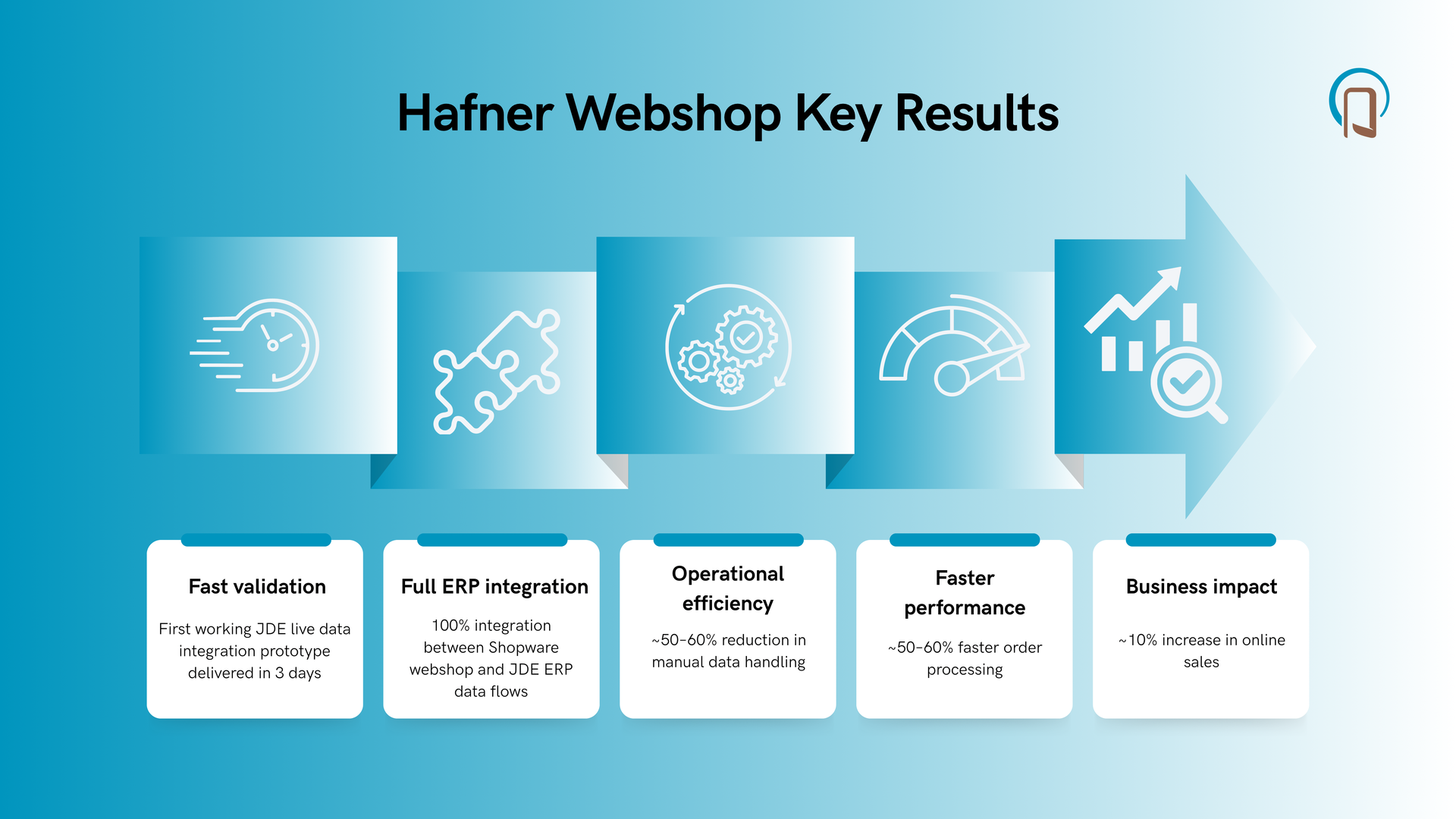
To answer that question, we put together a tiny test. It wasn’t pretty, and it wasn’t meant to be. It was a simple, bare interface whose only job was to pull real data from JDE. Three days later, it did exactly that. And the moment Hafner saw live JDE data appear on a simple web page, something shifted. The previous development was officially closed, and soon after came the much larger request:
Would we take over the entire webshop and rebuild it from the ground up?
We agreed, not yet realizing just how deep a journey this would become.
A Webshop That Needed Far More Than New Paint
Although Hafner’s old website had been reliable for many years, time had quietly moved past it. Its design belonged to an earlier era, mobile browsing lived on a separate subdomain, and publishing even simple updates felt like tiptoeing through a maze. But the biggest limitation wasn’t cosmetic, it was the lack of any connection to the ERP. Orders arrived as emails in sales inboxes, customer registrations remained isolated, and product updates required manual steps at every turn.
Meanwhile, JDE already held all the structured information the webshop needed: product data, pricing rules, availability, partner details, customer specifics, agreements, and the entire logic that defined how Hafner actually worked. The challenge wasn’t that the data didn’t exist, it was that the webshop had no way of receiving it.
What made this especially challenging was the nature of the new environment. The Oracle-based ERP handled data in ways that were far from standard, which meant that integration was not a straightforward task. Several vendors were able to quickly present visually appealing webshop concepts, but when the focus shifted to data handling and system connection, those approaches consistently fell short.
On top of this, Hafner’s B2B industrial setup added another layer of complexity. The logic behind pricing, customer-specific conditions, and production-driven workflows required a level of understanding that went beyond typical B2C webshop experience.
Then came the additional requirement from the German team: they needed their own site, but only as a catalogue. No checkout, no ordering, but still fully synchronized with the same ERP. And above everything else, Hafner made one point extremely clear:
The webshop must continue functioning smoothly even if JDE goes offline.
This single expectation shaped the technical decisions, data flows, and architecture right from the beginning.
Turning a Mess of Details Into a Clear Plan
Between late 2022 and early 2023, we spent months uncovering the full picture of what Hafner needed. Some parts were well documented, but others existed only in old email threads, half-written specifications, or personal knowledge living in people’s heads.
Integrating two systems is never just a technical job, it’s a matter of understanding how a business breathes.
Piece by piece, meeting by meeting, we mapped out how JDE structured product families, how customer data should move, how prices were calculated, what the catalogue logic meant for Germany, and how Shopware expected its own data to be shaped. Slowly, the puzzle pieces began forming a real image. What previously seemed uncertain became logical, and by spring, we had a roadmap both teams could trust, one that would finally allow the webshop and the ERP to speak the same language.
From Hafner’s side, one of the most important takeaways early on was that we didn’t start with design or visual concepts, but went straight into understanding data structures and business processes, the foundation everything else depends on.
Building Something That Works in Real Life
Development began in March 2023, and from the very first days it was clear that the key to this project would be the middleware, the layer between Shopware and JDE that would translate, synchronize and steady the entire data flow. We built it to understand both worlds, to handle customer registrations and updates, to pass orders and quotations into the ERP, to bring product structures and prices back into the webshop, and to keep operating even when JDE temporarily went offline.
While this engine quietly took shape behind the scenes, we worked on the storefront itself as well. The new webshop became more intuitive, fresher in design, better structured, and available in four languages — Hungarian, Slovak, English and German — offering Hafner a system that finally supported growth instead of limiting it.
Although certain design elements were developed together with other partners, the core system, including integration, logic, and implementation, was handled as a single, consistent solution.
Of course, we ran into surprises along the way, as every integration hides small details waiting to emerge. But as the weeks passed, the webshop began to feel alive, connected and ready for real users.
Launch Day — Calm, Surprisingly Calm
August 8, 2024, was the day the Hungarian webshop went live, and we arrived that morning prepared for all the typical launch-day excitement: unexpected bugs, server hiccups, and last‑minute fixes. There were a little nervousness, what if something goes wrong. And yet, almost miraculously, everything went smoothly. The webshop responded exactly as it should, data flowed between systems, and users experienced a clean, polished interface without ever knowing how much work was happening in the background.
The only challenge was that SEO tasks started later than planned, which taught us a valuable lesson about aligning every team around the launch date. But aside from that, the experience couldn’t have been more stable. By the time we launched the German catalogue in early 2025, the foundation was so solid that the second go‑live felt almost effortless.
More Than Just a Webshop
Looking at the completed system, it’s evident that this project evolved into something much more than just a redesign. Hafner now has a modern Shopware 6 webshop, a synchronised German catalogue, and a robust integration layer that connects all critical parts of their business, even when the ERP temporarily goes offline. Data flows automatically, content is maintained across four languages, and the webshop is no longer a separate entity but a true extension of Hafner’s internal processes.
As Hafner noted, once everything began working in harmony, the impact was almost immediate. Many small, everyday manual tasks began to disappear, and manual data handling dropped by 50–60%. This meant that work that had previously required two people could now be handled by just one. At the same time, order processing became significantly faster - by around 50–60% - making daily operations much smoother and easier to manage.
They also emphasised how much “cleaner” everything became overall. With manual data entry no longer part of the process, there was no need to fix typos or manage mismatched data across systems. Instead, everything is sourced from a single, reliable location, reducing the small but constant friction in day-to-day work.
Over time, this also reflected in the results. Not only did online sales grow by approximately 10% compared to the previous webshop, but managing product data also became significantly easier, with the required effort decreasing by roughly 40%.
Other processes saw similar improvements. Customer registration, which had once been a fully manual, time-consuming task, was automated. Additionally, orders and quotations became visible to customers, reducing unnecessary back-and-forth communication and simplifying daily work for both the internal team and their customers.
Reflecting on the collaboration and how these changes gradually developed, it often felt more like working with an engineering team than with a traditional web development agency. The focus was not solely on aesthetics but also on how the system performs under real-world conditions.
The project was conducted in a structured and transparent manner throughout, a key component that Hafner highlighted as essential for managing such a complex integration smoothly from start to finish.
What stood out for both sides was the mindset behind the work: whenever challenges arose, the conversation never centred on whether something was possible, but rather on how it could be solved.
Given that this journey has already brought together numerous teams, ideas, and late-night problem-solving sessions, it feels fitting to conclude with the thought that has lingered since the final launch:
Yes, Hafner’s webshop has finally found its voice. And honestly? We’re excited to see how the work has improved in their everyday life, not to mention the improved customer experience it has brought.